
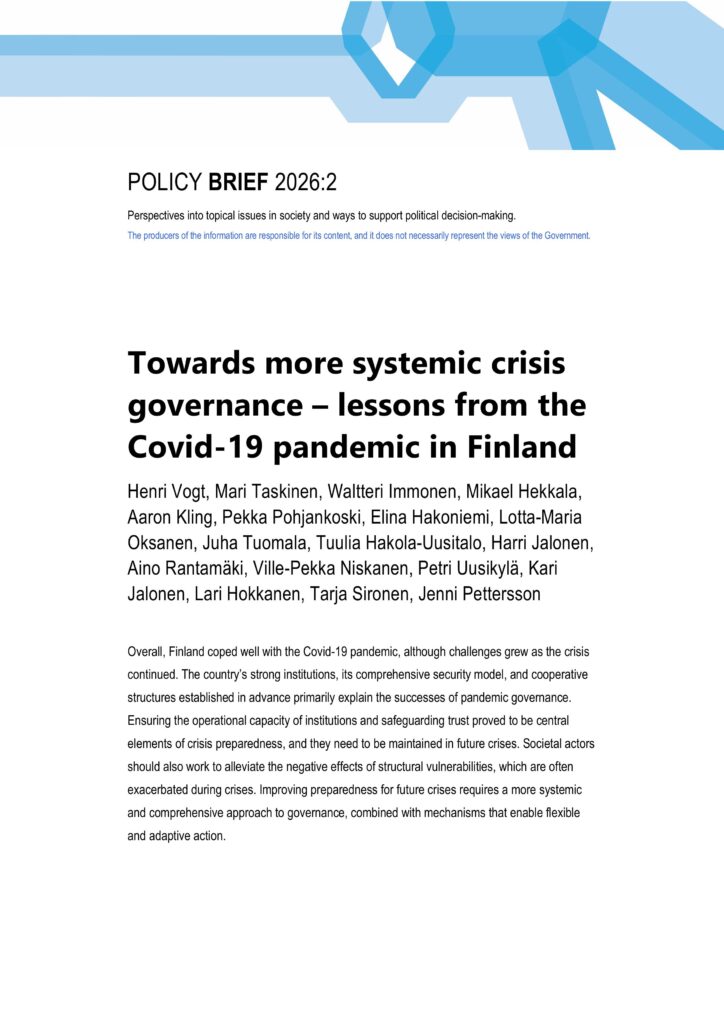
Finland managed the Covid-19 pandemic comparatively well. Yet the longer the crisis lasted, the more visible the limits of the governance system became. This brief examines what a prolonged crisis revealed about institutional strength, societal vulnerabilities, and the kind of governance future crises demand.
Finland’s pandemic response rested on three foundations: strong public institutions, a preparedness model based on comprehensive security, and established structures for cooperation. High institutional trust supported the response throughout the crisis. Citizens largely accepted restrictive measures, vaccination rates remained high, and public administration continued to function under pressure. Economic support measures also softened the immediate damage for businesses and households.
However, as the crisis extended beyond its acute phase, the governance architecture showed its limits. Information remained fragmented across administrative sectors, and coordination responsibilities were often unclear. Public communication also struggled. Citizens were not always able to distinguish between legally binding restrictions and official recommendations.
The burden of the crisis also fell unevenly. Existing inequalities deepened over time, particularly among groups already facing social or economic vulnerability. The integration of expertise and research-based evidence into decision-making remained inadequate in several phases. Economic support measures protected livelihoods in the short term, but poorly targeted support and delayed withdrawal increased public debt and intensified later adjustment pressures.
Running through all of these difficulties is a sense of uncertainty: how to make sound decisions when the evidence is incomplete, the situation is still evolving, and waiting for clarity is not an option.
The VNTEAS PAKO project, funded by Finland’s Prime Minister’s Office, approaches the pandemic as a systemic societal phenomenon. The project examines how sectors, institutions, and people became increasingly interdependent during a prolonged crisis. This policy brief, produced by the Universities of Turku, Helsinki, and Vaasa, VATT Institute for Economic Research, and Demos Helsinki, brings together the project’s main findings and recommendations for future crisis governance.
Key findings across six domains
The analysis points to a central tension: Finland’s governance system remained operational throughout the crisis, but its ability to adapt weakened as the crisis evolved.
| Epidemiology: |
| – Keeping infection rates low before broad vaccine coverage was a major achievement. – Effective collaboration in sample collection and processing enabled a rapid increase in screening capacity, and wastewater monitoring and genome sequencing proved to be important early warning tools for new variants. – Future preparedness must systematically consider airborne transmission. Long-term risk management should rely on layered protective measures that reduce the need for broad societal shutdowns. |
| Legal framework: |
| – Emergency legislation functioned largely as intended, and oversight authorities responded quickly. – But gaps in legislation and a lack of flexibility hindered governance, and legislative drafting capacity was strained. – The boundary between legally binding restrictions and government recommendations became blurred at several points. Communication about whether official guidance is binding and why is needed. |
| Crisis management and preparedness: |
| – Finland’s comprehensive security model provided a strong foundation for coordination. Public authorities, businesses, and civil society organisations already had structures for cooperation before the pandemic began. – Yet the crisis exposed fragmented information management, weak communication structures, and unclear coordination across administrative levels. – Networks and exercises developed in advance helped, but they could not resolve coordination ambiguities once the crisis intensified. |
| Economic policy: |
| – Economic support measures protected the foundations of the economy during the acute phase of the crisis. Rising unemployment and bankruptcies remained lower than initially feared. – Public finance buffers also proved essential during a large-scale societal shock. – The clearest economic governance lesson concerns timing. Extraordinary support measures require an exit strategy from the beginning, not after political pressure builds around their continuation. |
| Social sustainability and trust: |
| – Trust in Finland’s main institutions remained relatively high, positively contributing to governance successes. – At the same time, the crisis deepened structural inequalities across social, economic, and health-related dimensions. Future preparedness requires stronger recognition of how crises compound existing disadvantages over time. – Non-governmental and third-sector actors played a complementary role that formal governance structures must recognise in advance. |
| Evidence-informed policymaking: |
| – Finnish crisis governance showed a strong commitment to using the best available knowledge. Yet the relationship between expertise and decision-making shifted across different phases of the pandemic. – Uncertainty cannot be entirely eliminated in a crisis, but the capacity to govern under uncertainty can be strengthened through well-functioning interfaces between knowledge producers and policymakers, and through more open communication about what the evidence does and does not show. |
Towards more systemic and learning-oriented governance
The brief presents 18 recommendations clustered under three cross-cutting themes: systemic thinking, uncertainty, and flexibility. One organising principle holds across all of them: Crisis preparedness should be built primarily during times of normalcy, through clear institutional responsibilities, functioning communication practices, and preparedness structures that already incorporate social policy perspectives.
This requires complementing institution-based crisis management with a more adaptive governance model. Traditional crisis governance relies heavily on predefined roles and procedures. Systemic crisis governance also depends on continuous interaction, learning, and adjustment as conditions change.
In practice, this means adopting decisions incrementally and for limited periods, with review points agreed in advance. Beyond a technical instrument for decision-making, scientific expertise should also strengthen public trust in governance.
Lessons beyond Finland
The Finnish case matters because the system functioned well enough for its remaining weaknesses to become visible. Other governments operate within different institutions, different legal traditions, and different starting levels of public trust. The Finnish answers do not transfer directly, but the governance questions do.
Coordination often weakens once crises extend beyond their acute phase. Poorly targeted support measures can transfer long-term costs onto future public finances. Vulnerable groups tend to carry disproportionate burdens during prolonged emergencies. The relationship between science and policy also becomes increasingly strained when evidence evolves under public pressure for certainty.
They are the questions any government will face in the next crisis, and whatever form it takes, the need to move towards more systemic crisis governance will remain.
Read the full report (in Finnish): here.
Addressing the most complex problems of the 21st century demands a humble approach to policy-making
Post
November 13, 2020
Characteristics of a 21st Century Government
Publication
December 22, 2020
Humble Government: How to Realize Ambitious Reforms Prudently
Publication
December 14, 2020
WELGO — Safeguarding welfare in times of pandemics
Project
January 25, 2022
CO3: COntinuous COnstruction of resilient social COntracts
Project
March 13, 2024
21st Century Politics Require Governance Capable of Driving Transformation
Publication
December 11, 2020
A Call for Humble Governments
Publication
September 17, 2021
Towards long-term governance – From future awareness to action
Publication
January 21, 2025