
Foresight Friday 2025 brought together policymakers and global experts to discuss Finland’s long-term responsibilities to future generations and intergenerational fairness. The question remains open, and it belongs to all of us: what is our promise for future generations?
With the start of the new year, there is a tendency to reflect where the world currently stands and our place in it. Only weeks earlier, on the eve of Finland’s Independence Day, we deliberately paused to look towards future generations, helping us gain a richer and more long-term perspective on the present.
In Finland, Independence Day is traditionally a time when we pause to remember the generations who came before us: those who carried responsibility in difficult moments and laid the foundations of the society we live in today.
If we are grateful to those who preceded us, what will future generations remember us for? What kind of Finland are we shaping through today’s decisions?
On the 5th of December 2025, we hosted Foresight Friday: What is our promise to Finland’s future generations? We were honoured to welcome Sophie Howe, the first Future Generations Commissioner for Wales, as well as 4 Members of Parliament from the current Finnish Government. Sophie kicked off the event with a presentation on Wales’s experience, the international momentum around intergenerational fairness, and reflections on Finland’s position.
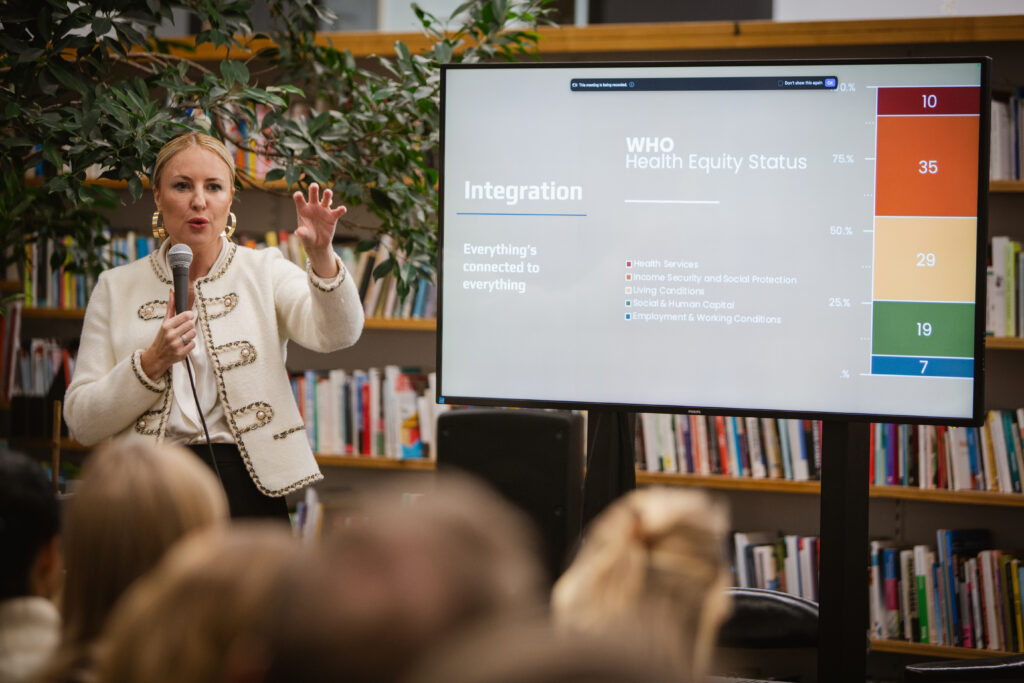
Additionally, we had the pleasure to hear reflections at hand from Jaana Tapanainen-Thiess from the Prime Minister’s office, Otto Tähkäpää from Sitra and Noora Vähäkari from Fingo.
This event was part of the long-term governance hub for Finland, initiated by the School of International Futures (SOIF). The purpose of the hub is to advance the objectives of the UN Summit of the Future in Finland. The partner organisations of the hub are Demos Helsinki, Sitra, and Fingo.
Five key conclusions emerged from the panellists and participants, all of which point to a shared direction: “Almost all key political themes cannot be resolved within a single government term, or even two.” It is thus imperative that these conclusions move beyond simply identifying the problem and acting daily and responsibly based on what we know.
1. The presence of “polycrastination”
Sophie Howe presented the term “polycrastination”, the delay in tackling a multitude of long-term societal problems. This was also reflected in the panel discussion. Our systems are still shaped by short electoral cycles, annual budgets, and narrow performance measures. This makes it difficult to act on a multitude of issues whose consequences unfold over decades, even when we want to.
“I would say the problem is that the discussions are not connected to one another. There is plenty of separate discussion about technological development, but when we talk about the sustainability of the pension system, the conversation focuses entirely separately on the need to extend working careers so that the pension system can endure.– In my view, the separation of phenomena, and of the discussions around them, is the core problem.”
“Employment relationships have already become atypical. It is difficult to get permanent work that would allow someone to take out a mortgage and start a family. If young people do not feel that life here is worthwhile for them, many who have grown up in an international environment may well leave abroad.”
2. Long-term action is just common sense
When we delay action, the long-term costs grow whether in care, mental health or ecological degradation. Long-term focus needs structures, not only intentions. Wales recognised this over ten years ago and chose to embed long-term responsibility into law.
“The mental health crisis is a very concrete example. When you consider that it costs us 11 billion euros, yet every four years we come up with something small, a few fixes. This is exactly the kind of issue where a plan could be made so that in 20 years’ time, we would no longer be facing this problem.”
“Almost all key political themes are such that they cannot be resolved within a single government term, or even two. The most obvious example is climate change: getting as many actors as possible to commit to shared efforts, in a way that ensures a change of government does not cause interruptions along the way.”
3. Strong call for a shared vision
A vision, even a broad one, that sets where we as society want to see ourselves in the future, that builds commitment across parties and parliaments and is owned by a national-level, citizen-led conversation. This sense of direction must be matched with the tools to act on it, from assessments to accountability.
“I place quite a lot of hope in the fact that, as a Finnish society, we still have a sense of mutual responsibility. The most important task for us as politicians is to strengthen and reinforce the feeling of togetherness.”
“If we want to address certain issues over the long term, that inevitably requires parliamentary cooperation. But that can feel somewhat uncomfortable for parties, because it means constant compromise and letting go of some of one’s own priorities in order to achieve something good.”
4. We have the foundations, but need leadership and commitment
Even though young people’s confidence in the future has declined, it was discussed in the panel that Finland has strong intergenerational solidarity, even stronger than politicians or we might think. Our foresight work is high-quality and globally recognised, but we need to use it intentionally.
“In many respects we are a model country in foresight. But how much of that actually translates into concrete legislation and day-to-day policy is, in my view, the real challenge. We talk a great deal about money, but we lack the ability to properly measure the value of human capital. The same applies to our natural capital”
“Many pensioners have come up to say that they are worried about their children and grandchildren. They would like more to be done on behalf of children and young people, and that is entirely natural, since the human species itself seeks continuity across generations.”
5. What do we want our promise to future generations to be?
Opportunity and freedom. Ability to lead good lives, unburdened by conflict or the debt of our decisions, or lack of today.
“Based on my experience in parliament. I have the sense that there is a genuine desire to make better policy and policy that takes the future comprehensively into account.”
“The problems that are being kicked down the road to future generations should be addressed more decisively now, and taken responsibility for by everyone.”
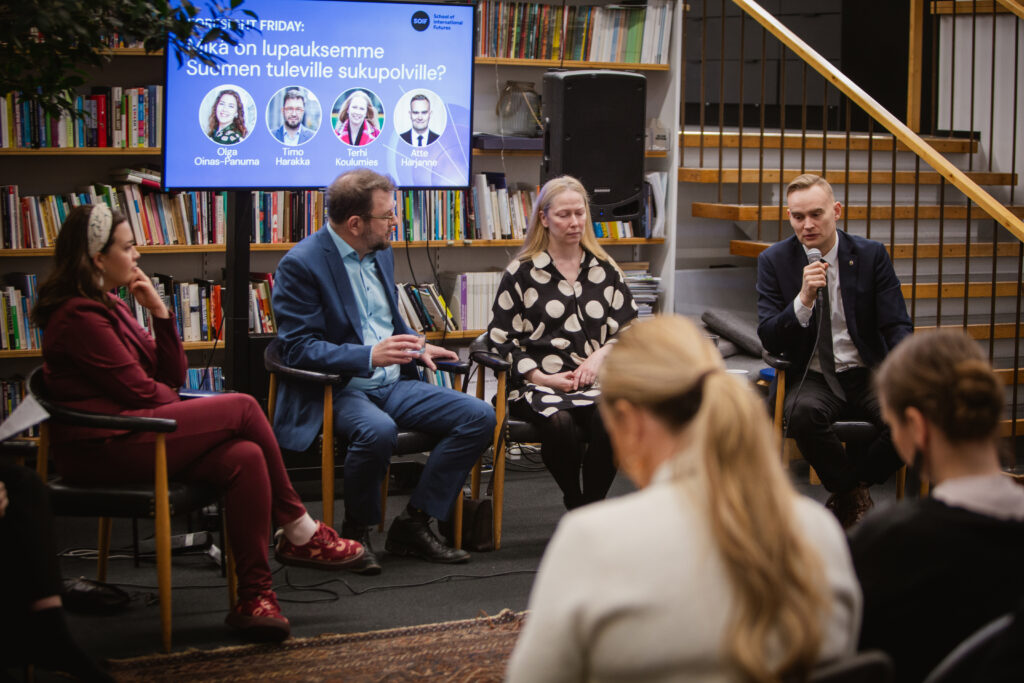
We were honoured to welcome the panellists on integrating the interests of future generations into decision-making, with
- Terhi Koulumies (National Coalition Party)
- Atte Harjanne (The Greens)
- Timo Harakka (Social Democratic Party)
- Olga Oinas-Panuma (Centre Party)
Right now, we need to intensify the conversation on how long-term responsibility is translated into everyday decision-making. The hub for long-term governance was created to enable this space: a place for dialogue and shared learning on how future generations’ interests can be meaningfully embedded in governance.
The question remains open, and it belongs to all of us: what is our promise for future generations?
Further reading and resources
Hub for long-term governance:
- Towards Long-Term Governance: From Future Awareness to Action (English)
- Kohti pitkäjänteistä hallintoa: Tulevaisuustietoisuudesta toimintaan (Finnish)
School of International Futures:
- One Year in Practice: Stories of Global Action for Future Generations
- Working for the Wellbeing of Current and Future Generations – Implementation Handbook for the UN Declaration on Future Generations
Demos Helsinki research and practice:
- MERGE: Building economic policies beyond GDP
Towards long-term governance – From future awareness to action
Publication
January 21, 2025
Kohti pitkäjänteistä hallintoa – Tulevaisuustietoisuudesta toimintaan
Publication
December 12, 2024
Towards systemic innovation: how foresight can help organizations transform
Post
September 16, 2021
The anticipatory policy cycle: not just preparing for the future, but influencing it
Post
May 14, 2025
Foresight and policymaking: lessons from Singapore and Finland
Post
September 26, 2022
Foresight enables to prepare for crises but also look beyond them
Post
April 2, 2020
MERGE: Building economic policies beyond GDP
Project
April 15, 2024