
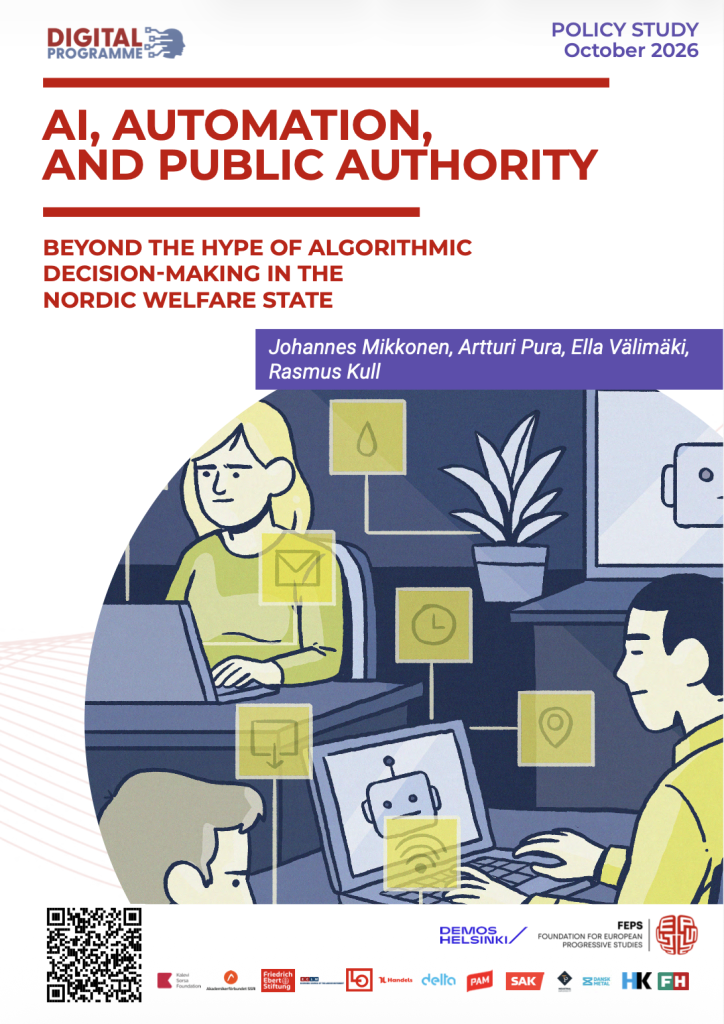
Nordic public administrations are among Europe’s most digitally advanced. Demos Helsinki’s policy study for FEPS examines three automated systems in Norway, Finland, and Sweden and sets out thirteen recommendations for public organisations and policymakers on governing automation.
While governments increasingly look to AI and automation for public-sector efficiency gains, the study shows that these benefits do not emerge automatically. Automation can reduce routine work, but it also creates new tasks and requires sustained investment in organisational capabilities, professional expertise and system oversight.
Three cases of automation and AI in Nordic public administration
A broader mapping of Nordic automation was narrowed to three cases: Norway, Finland and Sweden. They were chosen for variation in sector, governance model and type of automation. The study combines desk research, semi-structured interviews and qualitative comparative analysis.
The Norwegian Labour and Welfare Administration (NAV) automates routine sickness-benefit decisions. Caseworkers handle the complex cases. One caseworker described how he previously processed 117 cases a day and now handles between two and 15.
The Finnish Immigration Service (Migri) has introduced automated decision-making for straightforward positive decisions across eight residence permit categories. More complex cases requiring legal interpretation remain with civil servants. Migri outsources technical development, while it retains control over legal interpretation and the rules governing automated decisions. Casework has become more fragmented: as one interviewee put it, work that once covered the “whole pie” now involves “bits and pieces” of it.
The Swedish Public Employment Service (PES) uses a machine-learning tool to profile jobseekers. The tool predicts the likelihood of finding work within six months and recommends a level of support. Caseworkers formally make the decision, but overriding a recommendation requires additional, documented justification.
Eight cross-case learnings
The cross-case analysis identifies eight key findings about how automated decision-making and AI affect accountability, transparency, discretion, civil servants’ work and public trust in the Nordic public sector.
- Automation improves efficiency but creates new forms of complexity.
- Automation does not remove discretion but relocates it.
- Automation fits standard cases better than complex human lives.
- Automation reshapes public-sector organisations and work.
- Trust depends less on technology and more on fairness, accountability and human access.
- Automation transforms professional identity and the meaning of civil-service work.
- Outsourcing may create new governance dependencies.
- The gap between policy ambitions and practical implementation is systemic.
The central finding across the three cases is that automation redistributes work, discretion and accountability. Human decision-making is reorganised rather than simply replaced. Professional judgement increasingly shifts from individual case handling towards system design, legal interpretation, organisational procedures and human oversight. At the same time, responsibility does not always shift together with decision-making power. In Sweden, for example, caseworkers remain formally responsible for decisions even as their practical ability to shape them becomes more constrained.
Thirteen recommendations for administrations and policymakers
Based on these findings, the study presents thirteen recommendations.
| Recommendations for public administrations | Recommendations for policymakers and regulators |
| 1. Ensure meaningful human oversight | 1. Recognise automation as organisational change, not just technological change |
| 2. Invest in organisational capacity, not just technology | 2. Move beyond technical compliance towards organisational accountability |
| 3. Involve frontline civil servants throughout design and implementation | 3. Protect discretion where public administration requires interpretation |
| 4. Safeguard accessibility and fair treatment in public services | 4. Strengthen data governance without undermining fundamental rights |
| 5. Efficiency cannot be achieved through economic efficiency alone | 5. Strengthen public-sector capability in procurement and vendor governance |
| 6. Build automation incrementally and institutionalise learning | 6. Support systematic learning between European public administrations |
| 7. Consider public-sector work within future AI-at-work regulation |
Public authority cannot be automated away
Automation does not eliminate the responsibilities of public administration. Authorities must still interpret the law, justify decisions and ensure that citizens can challenge them. The question is therefore not simply how much public-sector decision-making can be automated, but which decisions should be automated, under what conditions and with what safeguards.
The policy study was published in October 2026 by the Foundation for European Progressive Studies (FEPS). Demos Helsinki produced it as part of the FEPS-Nordic Digital Programme, which brings together FEPS, its member foundations, and trade unions in Denmark, Sweden, Norway, and Finland. It was produced with the financial support of the European Parliament.
Automation should not be treated as a shortcut to public-sector savings. Its benefits depend on sustained investment in people, organisational capabilities and effective governance. The study offers public administrations a way to assess what automation will do before implementing new systems. For national and European policymakers, it grounds the case for extending AI governance into organisational practice. For unions and civil servants, it records how these changes are experienced by frontline workers. If you want to discuss the report, contact Johannes Mikkonen johannes.mikkonen@demoshelsinki.fi.
New research aims to define what “successful AI” means in society (FORSEE)
Project
April 17, 2025
Technology for society
Theme
December 11, 2025
KT4D: Fostering democracy through knowledge technologies
Project
November 21, 2023
Navigating impactful R&I policy and technology neutrality
Project
January 8, 2024