
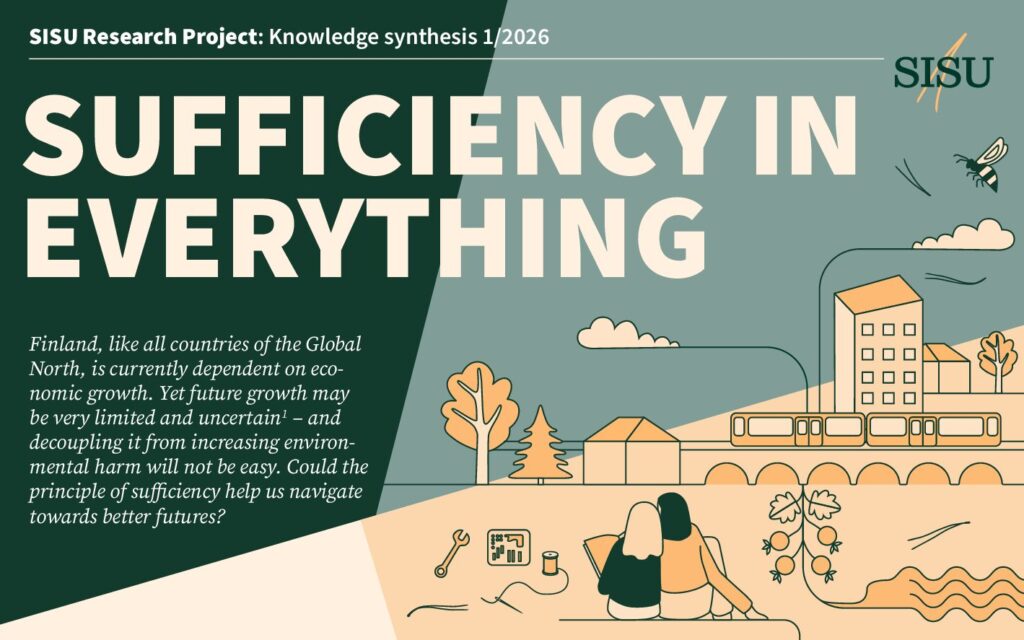
Finland, like all countries of the Global North, is currently dependent on economic growth. Yet future growth may be very limited and uncertain – and decoupling it from increasing environmental harm will not be easy. Could the principle of sufficiency help us navigate towards better futures?
Why sufficiency matters
Current proposals for a better future, especially those from political leaders, rely almost solely on economic growth. This seems risky. Current forms of economic and human activity produce not only progress but also increasing challenges. So-called green growth, or decoupling economic growth from the increasing use of natural resources, has proven to be challenging.
This is why sufficiency matters. Sufficiency refers to understanding and living within the limits of what is enough. It focuses on maintaining wellbeing while reducing resource use, and on avoiding both scarcity and excess. Scarcity is shaped by how justly resources are distributed, while excess is determined by ecological limits. The central promise of the welfare state, to protect those in a vulnerable position in society, is emphasised in a sufficiency framework.
This differs from related concepts. Efficiency aims to produce more output with fewer inputs. Sufficiency instead asks how much output is needed to sustain a good life. Degrowth centres on reducing economic activity. Sufficiency takes a different approach by reorganising economic and social activity so that it meets human needs without exceeding ecological boundaries.
Sufficiency as an economic and societal principle
Decoupling economic growth from greenhouse gas emissions, unsustainable resource use, and other environmental harms has been thus far slow and limited. As a result, environmental challenges are likely to persist even if the full potential of technological solutions were realised. Technological solutions alone are not enough – sufficiency measures are required to steer both demand and supply towards ecological sustainability.
Sufficiency solutions extend well beyond individuals’ everyday choices to include political decision-making. The “Sufficiency in Everything” synthesis identifies five types:
- Quantitative sufficiency: the appropriate amounts of resources owned, produced, or used. Examples include reducing food waste and choosing renovation over new construction.
- Qualitative sufficiency: the appropriate quality, type, or size of resources, such as choosing lower-impact construction or partially replacing animal proteins with plant-based alternatives.
- Use sufficiency: how resources are accessed over time, including prioritising repairability, reuse, and reduced VAT on second-hand goods and repair services.
- Sharing sufficiency: how resource use is distributed through social practices, from car-sharing schemes and tool rental services to shared public spaces and library services.
- Steering sufficiency: the systems, incentives, and rules that make all of the above more likely, through tools such as taxation, advertising restrictions on high-impact products, and behavioural campaigns.
These solutions support the private and public sectors, as well as civil society, in embedding sufficiency thinking across their practices.
Are we ready for sufficiency?
Sufficiency has a strong place in Finnish values and cultural heritage, shaped in particular by the experiences of those who lived through the 1930s to 1960s, marked by war and the period of scarcity that followed. In the SISU study, interviewees aged 65 to 82 from North Karelia described sufficiency in personal terms: what they feel they need, what they could let go of, and what kinds of pleasures are beneficial.
In extreme cases, interviews conducted with prisoners reveal that when the scope of life and available choices are reduced to meeting basic needs, what is simply ordinary can be enough. Wellbeing is thus possible without continuous increases in production and consumption.
European-wide surveys show that citizens are willing to support sufficiency-oriented measures as part of the sustainability transition even when change comes at a cost. More than 80% of European citizens support the adoption of metrics that go beyond GDP. In Finland, 91% of people believe products should be designed to last longer, even if this increases their price. 80% believe non-essential production and consumption should be reduced for environmental reasons.
What comes next
The “Sufficiency in Everything” knowledge synthesis, based on peer-reviewed research articles and collected data produced within the Sufficiency solutions for a resilient, green, and just Finland (SISU) research project, serves as a discussion starter to examine sufficiency as an everyday matter, a principle of economy and society, a practice of sustainable society, and a basis for the good life.
While many questions remain open regarding both theoretical and practical implications around the sufficiency framework, the SISU project, funded by the Strategic Research Council established within the Research Council of Finland, will continue working to find pathways through them.
MERGE: Building economic policies beyond GDP
Project
April 15, 2024
Doomed to Grow?
Publication
December 3, 2025
Doomed to grow or ready to transform?
Post
December 3, 2025
What’s going on with GDP? Rethinking economic success
Post
March 7, 2025
‘The Economy of Wellbeing’ Builds Sustainable European Union
Project
February 1, 2020
How to introduce a wellbeing economy model
Post
June 30, 2022
Policy Brief: Path2030 – Evaluation of Finland’s Sustainable Development Policy
Publication
March 19, 2019
For a wellbeing economy, we need to transform governance
Post
March 31, 2023
SISU: Sufficiency solutions for a resilient, green and just Finland
Project
March 10, 2026
BlueAdapt – Enhancing Adaptive Capacity for Sustainable Blue Growth
Project
April 3, 2018