
Europe’s need for care is growing and changing, and treating it as a crisis misreads the change. Demos Helsinki’s report, The European Care Contract, frames care as a transition and part of the social contract and asks how the duty to give care could become as universal as the right to receive it.
Throughout our lives, we will all give care and receive it. Care is both a right and a duty. While our current care system is running under heavy constraints, mainstream debate treats it as a crisis of labour and budgets, to be fixed so things can return to normal.
That misreads the change: there is no normal to return to. The need for care is growing and changing character. No longer a temporary spike, care need has become a lasting shift, driven by ageing, chronic illness, mental ill-health, isolation, and recurring social and economic shocks. It is therefore more accurate to describe this as a care transition, on the same scale as decarbonisation or digitalisation.
For this transition to be fair, Europe needs to redesign the social arrangements and institutions behind care. Demos Helsinki’s report, The European Care Contract, asks how the duty to give care could become as universal as the right to receive it, and proposes four mechanisms and an EU pathway to get there.
A fairer care contract moves Europe towards regeneration
Care works as a cycle: it begins in vulnerability, moves through relationships and accountabilities into caregiving, and, when adequately resourced, replenishes the capacity it draws on. The cycle renews itself only in a steady state when needs and resources stay in balance. The postwar welfare settlement came close to that balance, though it rested unevenly on women’s unpaid work at home – an arrangement that should not be restored.
Those steady conditions also no longer hold. The European Commission projects a shortfall of 1.6 million formal caregivers by 2050, while need grows fastest among people over eighty. The strains are already well documented: needs go unmet, the care workforce is thinning at both ends, and those carrying the remaining load are worse off in health, income, and employment. The care cycle has become a spiral that can degrade or regenerate.
Which way the spiral turns depends on how care is shared, and the consequences reach well beyond the care sector. Care is among the most frequent and least avoidable ways people meet public institutions, often at their most vulnerable moments, so its fairness shapes how far people trust those institutions and one another. Research finds that institutions that treat everyone as equals tend to build trust, and European survey data links unmet care needs to lower trust.
This makes care part of the social contract, the everyday agreement between citizens and institutions, and between citizens themselves: a care settlement is also a cohesion settlement. Renewing that contract towards regeneration starts with a fairer standard for sharing care.
Care for everyone, care by everyone
Everyone is entitled to receive care, and the obligation to sustain it is shared across the whole population.
Universal care means care available to everyone as a right, based on residence or citizenship, good enough that the well-off do not turn to private alternatives, and paid for together. The ideal carries weight across Europe’s welfare traditions, yet care is mostly organised in two ways that fall short of it. Service care, public or marketised, promises care to all, yet in practice rations it by eligibility or ability to pay. Family care returns the work to households, where it mostly falls on women, while others are exempt by gender or means.
Between public services and private homes lies a third ground, where neighbourhoods, communities, and cities organise care together: collective care. Cities and states have already shown they can build on it, from Bogotá’s Care Blocks to Japan’s Fureai Kippu time bank. However, collective care is bottlenecked at governance. No institution owns this ground, civil society landscape is more fragmented than a generation ago, and no one has designed the rules that would make participation universal. Left voluntary, community care tends to stand in for cut services, coverage stays modest, and the work drifts back to women.
Four mechanisms to redistribute care resources
Governing collective care means governing the three resources it runs on, which sit across the whole of society and well beyond the health and social sector:
- Time: protected time to give and receive care without economic penalty. Today, households with secure jobs, savings, and flexible employers can do so while others cannot.
- Relationships: the everyday fabric of trust and connection that sustains care, which depends on stable housing, mobility, and access to public space.
- Individual capabilities: the strengths people bring to giving and receiving care, shaped by education, health, economic security, and social connection.
Two enabling factors decide how these resources are shared. Accountabilities turn the personal responsibility for someone’s wellbeing into an obligation that is named, assigned, and enforced across individuals, employers, and the state. Collective tools and institutions are the shared infrastructure that allocates and replenishes the resources.
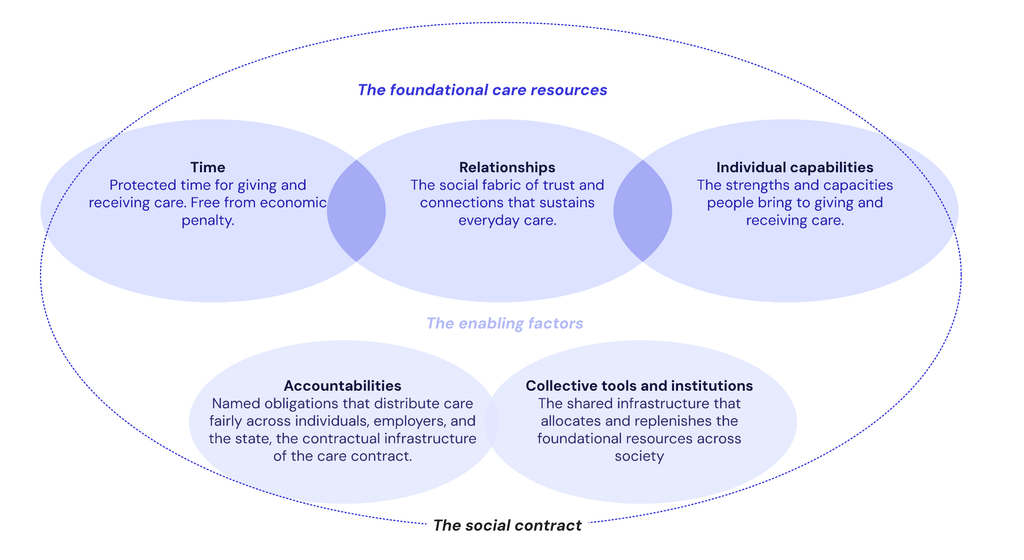
The four mechanisms we propose put collective care into practice, each addressing one resource or enabling factor.
- Relational hubs rebuild relationships by turning libraries, cultural venues, and civic spaces into neighbourhood points for care advice, peer support, respite.
- Time-for-care guarantees and credits protect time, since caring hours earn portable credits paid out as leave, shorter hours, or pension contributions.
- Employer care compacts bring accountability into working life, making predictable schedules and protected leave standard for workers with care responsibilities, agreed in advance by social partners (e.g., employers, trade unions).
- A civic care service spreads accountability across the population, asking everyone to give some time to care in roles matched to their abilities, while people receiving care decide whether to accept help and have a say in who provides it.
The mechanisms are illustrative policy levers and a set of entry points among several. Each mechanism addresses a different part of the system, and together they aim to change how care is organised, which requires pressure and support from several directions at once.
Start the pilots with the EU’s existing building blocks
Care has no legal basis in the EU Treaties, leaving the EU with plenty to say about care but little power to decide on it. Yet the care transition runs through work, housing, and public space, where the EU does hold instruments.
In the short term, existing funds such as the European Social Fund Plus can pilot relational hubs, time credits, and employer compacts, tracked against new indicators, e.g., care time, caregiver strain, and service pressure. The European Care Deal, expected in 2027, should set long-term care targets and establish a European Carers’ Statute. In the long term, Europe needs a binding care framework and dedicated care funding.
Building the care contract also raises questions the report deliberately leaves open: who convenes the negotiations, who holds the data, and who decides when a pilot becomes an entitlement. Those who take on new obligations should help set them, and we want to work through these questions with anyone willing to try.
We wrote the report for national and local governments, employers, trade unions, and civil society organisations that want to move the care debate to the question of how. If you want to be part of accelerating the care transition, put a pilot in practice or would like to discuss the report, contact Cecilia af Hällström at cecilia.afhallstrom@demoshelsinki.fi.
The report was developed by Demos Helsinki with funding from the Calouste Gulbenkian Foundation.
Vision Paper: Care – from crisis to transition
Publication
September 16, 2024
A new logic of care
Project
January 15, 2024
The future we share: How changing the social contract can support a just transition
Event
September 1, 2025
Care, ageing, and how to amplify our imagination
Post
December 9, 2024
Rethinking the social contract in the post-pandemic world
Post
July 8, 2021
The Economy of Wellbeing – a new narrative
Post
March 26, 2021
What if: Mental health through transforming the economy
Post
June 27, 2023