
For cross-cutting policy issues, like the transition to circularity, Demos Helsinki has developed a model that works: beating uncertainty through action, empowering relevant stakeholders with autonomy in problem solving, building a shared coordination structure, and adapting through learning what works. The model has been proven to move the circularity agenda forward, despite its complexity and fluctuating political significance.
Resource extraction has tripled since 1970, and on current trends, it could rise by a further sixty per cent by 2060 against 2020 levels. This will exacerbate the planetary crisis and drive economic risk, including price volatility and supply chain disruption. Linear waste, materials extracted, used once and discarded, costs the global economy €25.4 trillion a year, close to a third of global GDP. While circularity was expected to counter this trajectory, the Circle Economy’s Circularity Gap Report puts the world’s circularity rate at 6.9 per cent, the lowest figure the metric has recorded since its introduction in 2018.
Lack of ambition has not been the problem in advancing circularity. Ministries, cities and companies have had circularity on their agenda for over a decade. What has been missing is the architecture that turns a shared agenda into shared action, especially among actors who have little inherent incentive to work together. While circular frameworks and strategies are increasing worldwide (UNIDO & Chatham House, 2025) and technical solutions are increasing, implementation is not matching up to that intent. That intent-impact gap, and the governing capacity and coordination required to bridge it, is what Demos Helsinki can help strengthen.
Circularity is a cross-cutting challenge
Circularity gets filed under environmental policy by default. It usually lands with a ministry of environment, because that’s where an “environmental issue” is assumed to belong. That framing misses what circularity really is, rendering the approach inadequate.
Circularity surely is an environmental issue, but it is also:
- economic, since it decouples growth from material inputs
- social, through the job creation, wellbeing, and affordability it can support
- technological, in what it prevents by way of lock-in to linear design
- a matter of security and resilience, in reducing dependence on external material flows
- institutional, in the silos it requires breaking between trade, finance and environment and others.
- ethical, in what it protects for future generations and vulnerable groups today.
Given its cross-cutting character, no single department or actor can drive the circular transition alone. An environment ministry can set a recycling target, but it typically holds no authority over the trade rules that govern material imports, the industrial subsidies that shape what gets built, or the fiscal incentives that make virgin materials cheaper than recycled ones in the first place. The target is set in one office, while the decisions to meet it are made in three others. How we (re)organise, coordinate, and align these different mandates, therefore, matters.
| Dimension | The circular opportunities | The circular opportunities |
| Environmental | Moving away from a take–make–dispose model | Increase the value of the resources by lengthening their lifecycles, while minimising environmental impact |
| Economic | Value retention over material expansion. | Decouples growth from inputs; boosts productivity. |
| Social | Labour-intensive linear models (Repair/Reuse). | Improves affordability and localised job creation. |
| Technological | Design-led system architecture. | Prevents “technological lock-in” to linear systems. |
| Security & resilience | Diversification of material flows. | Reduces external dependencies; strategic autonomy. |
| Institutional | Cross-sectoral policy coordination. | Breaks silos between, e.g. trade, finance, and environment |
| Ethical | Intergenerational resource responsibility. | Protects future capacity and vulnerable groups. |
The enabling architecture for circular economies: thin consensus, thick commitment
The kind of change that circularity brings about comes with a predictable set of challenges:
- deep uncertainty about what will work,
- pressure to act urgently while still holding a long-term goal,
- disagreement on direction before anyone’s agreed what to do,
- no existing structure for the actors involved to coordinate through,
- and problems too complex for any one body to solve alone.
Demos Helsinki’s Humble Governance model recognises those challenges and works with them rather than around them. Uncertainty cannot be resolved before acting, so it is treated as inevitable: the response is constant iteration as certainty increases over time. Tension between urgency and long-term ambition is addressed through learning by doing. Continuous experimentation builds toward the longer goal without anyone needing to wait for certainty. To resolve disagreement over the direction, a broad shared framework gives actors ownership of the goal and autonomy to pursue it in their own way, without requiring full agreement on every detail before anyone can act. That autonomy still needs somewhere to land, which is why the model also builds a supporting, cross-sectoral structure that actors can use to identify and work through systemic bottlenecks together, so nobody is left figuring it out alone. The challenge that these problems are too complex and unstructured for any single centralised body to solve is met by leaning on cooperation between local expertise and independent research instead.
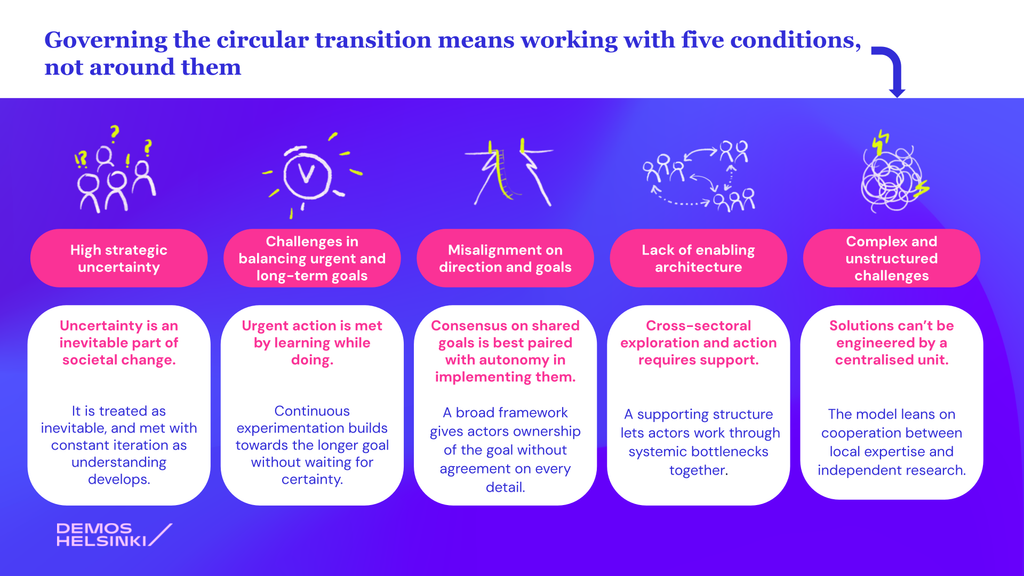
What holds this together is less a method than a disposition: the honesty to recognise that no single actor can resolve such a challenge alone and the humility to accept that nobody involved has the full answer at the outset.
The Humble Governance model has already been applied in several challenges that carry similar traits (uncertainty, long-term, with multiple actors, lack of coordination structures, and complexity) — including on the topic of circularity.
Circular Economy Green Deal (2022-2024, in collaboration with Ministry of Environment and Ministry of Economic Affairs and Employment)
The Circular Economy Green Deal is the clearest case of this governance approach applied. Finland had committed to phasing out coal by 2029, reaching carbon neutrality by 2035, and capping its use of natural resources while doubling both its circular economy rate and resource productivity by the same year, targets ambitious enough that Finland recognised early they would not be met without a change in how government itself worked, not only in what it asked of industry.
Demos Helsinki facilitated the co-creation process leading up to the development of the Circular Economy Green Deal – a steering instrument that catalyses collective action towards circularity based on voluntary commitments. The process was led by the Ministry of Environment and Ministry of Economic Affairs. The process brought together several ministries, research institutes, and close to ninety organisations, spanning most of Finland’s regions, its largest cities, and key businesses and industry associations, to identify and validate a shared, science-based framework and collective objective. Each actor then chooses its measures to pursue the collective objectives.
Humble Timber (2021-2022, in collaboration with 9 actors, including Ministries and Regional Councils))
Humble Timber applied the same approach to a narrower, self-contained problem: a deadlock between the supply and demand for timber construction in Finland. Finnish cities, which hold a planning monopoly over what gets built within their borders, had ambitious housing targets. But including timber buildings in those plans required confidence that enough production capacity and skilled labour already existed. Each side was waiting on the other. The industry couldn’t offer that confidence without firm demand signals from cities, and cities couldn’t give firm demand signals without confidence the buildings would actually get built.
Escaping that loop meant building capacity on both sides at once rather than waiting for either side to move first. Humble Timber assembled a nine-actor coalition, a ministry, a regional council, a housing foundation, developers and industry federations among them, to work through the deadlock together, using the same thin-consensus, autonomy-with-accountability. Finland’s then Environment Minister endorsed the results publicly, and they’re published as the Book of Humble Timber Construction, currently available only in Finnish.
Nordic Near-Zero Steel (2025 – ongoing, in collaboration with companies from the entire steel supply chain)
The Nordic near-zero-emissions steel project takes the same approach into a setting where private-sector actors choose to steer the agenda themselves, without a government or public body starting the process. The steel sector accounts for approximately 2.8 gigatonnes of CO2e emissions annually, or 8% – 10% of total energy system emissions globally. The Nordic countries are home to some of the world’s leading producers of near-zero emissions steel, as well as to leading companies developing products that create demand for that steel. This project aims to accelerate decarbonization in the steel industry by aligning efforts across sectors and coordinating Nordic policy action. Together with 9 industry partners and 2 philanthropic foundations, we are building a cross-value chain initiative to accelerate decarbonisation of the Nordic steel industry and that can scale across Europe and beyond.
Mainstream industry associations tend to settle on whatever the most conservative members will accept. That dilutes the position of companies already investing ahead of the rest of the sector in low-carbon production. The project therefore brings together the actors already committed, steelmakers, construction firms, energy providers and engineering companies, along with the policymakers and financiers whose decisions shape what’s commercially viable, and lets them build consensus among themselves towards carbon-neutrality in steel-making.
Participation is not confined to meeting rooms
How we govern extends beyond public institutions. For example, Think Sustainably was an initiative in Finland bringing together individual businesses and residents’ everyday choices. Demos Helsinki, the City of Helsinki and local sustainability experts built a set of circularity-relevant criteria, covering things like waste management and energy use, that businesses could opt into. Those that met the criteria were surfaced on MyHelsinki, the city’s official tourism and lifestyle site, giving residents and visitors a way to identify genuinely sustainable options for themselves instead of relying on businesses’ own claims. One participating business, the shopping centre Kämp Galleria, cut its CO2 emissions by 375 tonnes within a year after switching to renewable district heating and hydroelectricity to meet the criteria. Of the 80 Helsinki-based companies in the pilot, ninety per cent said the criteria motivated them to adopt more sustainable practices, and the platform reached 2.5 million people through MyHelsinki in 2021 alone.
Drawing it together
The €25.4 trillion lost every year to linear waste won’t close through better recycling technology or a stronger product standard. Both matter, but neither reaches the ministries, cities, competing companies and regional authorities whose coordinated action circularity depends on. Our work reveals that a different approach to governance — a goal loose enough to gather people around, a framework flexible enough to let each actor pursue it their own way, and a process patient enough to let trust thicken through action is required. This approach requires strategic shifts in how circularity is governed and how policies are designed. Together with United Nations Industrial Organization, we have identified three strategic shifts for governing circularity that help closing the intent impact gap:
- Targeting circular policies where they matter the most
- Designing them with more involvement
- Repositioning circular economy as a cross-cutting developmental priority
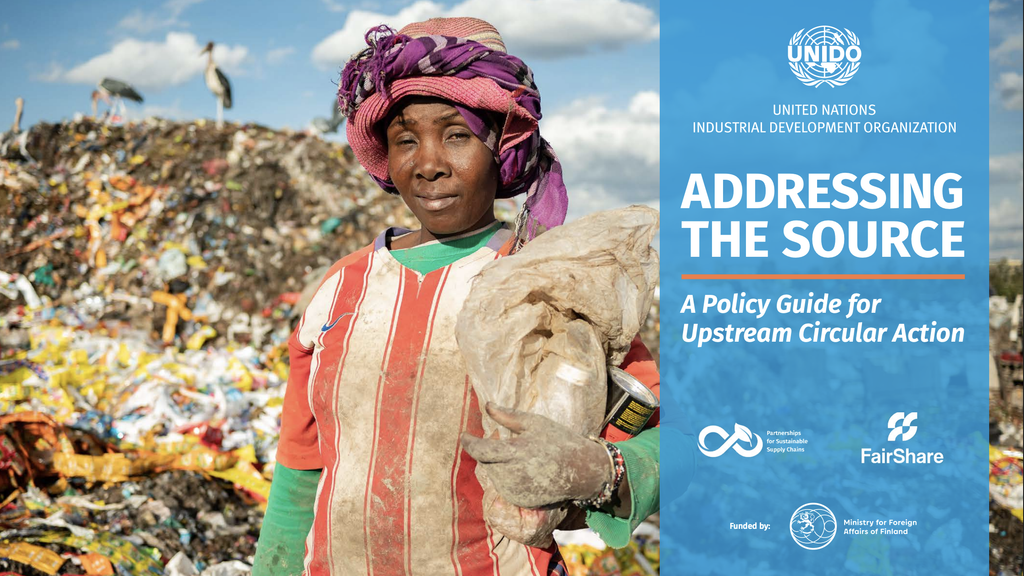
These shifts are about how we govern, how we approach policymaking, and how we design the policies that matter. Operationalising this requires choosing the instruments and mechanisms, and approaching them through these shifts. In the policy guide: Addressing the Source, developed together with UNIDO, the approach to governance meets the options available for putting them into practice. It assembles five policy instrument categories with 34 specific policy actions.
Beyond the technical aspects of this work, the most exciting outcome is observing relevant actors find the space and time to do what they know is right, get rid of inefficient and unnecessary constraints, and, most of all, have an incentive to do it together. We thank you for your courage and conviction to lead by example. You are the pioneers.

For more information, you can contact Cecilia af Hällström.
World Circular Economy Forum 2026: Four shifts to unlock the upstream circular economy
Event
August 21, 2026
Circular Economy Green Deal – a steering instrument for collective action towards circularity
Project
November 29, 2024
Designing circular economy policies where they matter the most
Publication
November 5, 2025
Safeguarding Finland’s future: The interplay of circular economy and comprehensive security
Project
June 29, 2023
Think Sustainably: Incentivising sustainable choices in cities
Project
May 23, 2022
Humble Timber: A project for urban carbon-neutrality
Project
March 9, 2022
Pioneering the future of steel: the Nordic Near-Zero Emissions Steel project
Project
October 17, 2025
A Call for Humble Governments
Publication
September 17, 2021
An operative model for implementing missions
Publication
May 8, 2023